
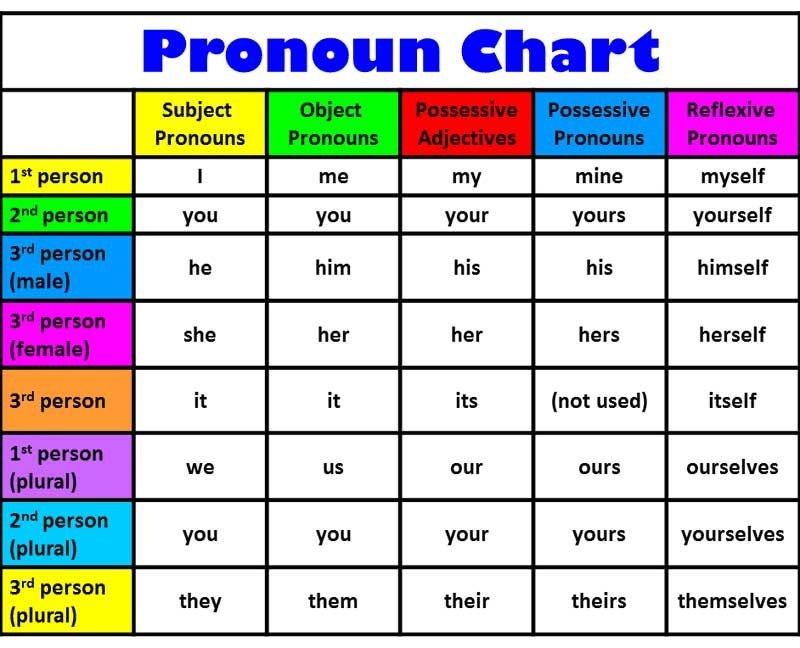
➣I love my cat
➣You love your cat
➣He loves his cat
➣She loves her cat
➣We love our cat
➣You both love your cat
➣They love their cat
➣He tolerates me
➣He tolerates you
➣He tolerates him
➣He tolerates her
➣He tolerates us
➣He tolerates you all
➣He tolerates them
➣I tell myself that he is mine
➣You tell yourself that he is yours
➣He tells himself that he is his
➣She tells herself that he is hers
➣We tell ourselves that he is ours
➣You tell yourselves that he is yours
➣They tell themselves that he is theirs
What is a pronoun?
Pronouns are some of the most useful words in the English language. They are used in the place of a noun to avoid it having to be named twice.
Definition of Pronoun
In English, the part of speech used as a substitute for an antecedent noun that is clearly understood, and with which it agrees in person, number, and gender.
Pronouns are classified as
➫Personal or Subject Pronouns ➭used before the verb
I, you, he, she, it, we, you, they
➢I am vegan
➫Object Pronouns ➭used after a verb or a preposition
me, you, him, her, it, us, you, them
➢Look at me
➫Possessive Adjectives ➭always used with a noun
my, your, his, her, its, our, your, their
➢My cats are my family
➫Possessive Pronouns ➭replace the noun
mine, yours, his, hers, ours, yours, theirs
➢That poem was mine
➫Reflexive Pronouns ➭the subject and the object of the verb are the same
myself, yourself, himself, herself, itself, ourselves, yourselves, themselves
➢I ask myself how you can do that
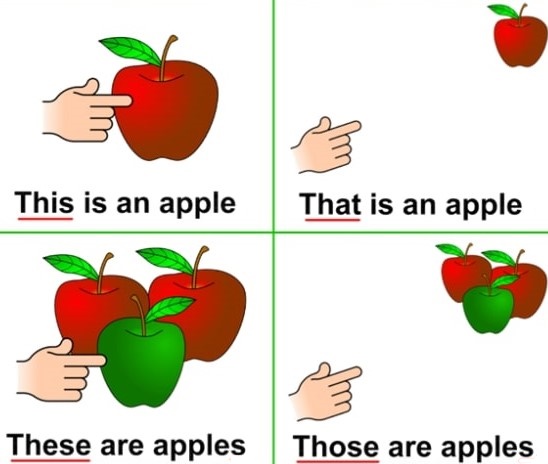
➫Demonstratives ➭point to the object according to the distance
this, these, that, those
➫Relatives ➭add information and relate back to what was previously mentioned
that, which, who, whom, whose, when, where, why
➢The teacher that/who speaks Russian is from Spain
➢The teacher whose parents speak Russian is from Spain
➢This is where I was born
➫Interrogatives ➭used to ask questions
what, who, which, when, where, why, how, whose, whom
➢What are you eating?
➢Why do they put birds in a cage?
- What ➮qué 🠾asks about a thing
- Who ➮quién 🠾asks about a person
- Which ➮cuál 🠾asks about a choice
- When ➮cuándo 🠾asks about a time
- Where ➮dónde 🠾asks about a place
- Why ➮por qué 🠾asks about a reason
- How ➮cómo 🠾asks about a manner
- Whose ➮de quién 🠾asks about ownership
- Whom ➮a quién 🠾formal
- How many cats are here?
- How much does it cost?
- How often do you see her?
- How long is the film?
- How old are you?
- How far is Madrid?
- How fast can you run?
- How big/tall/high is it?
- How wide/deep is the well?
➫Indefinites ➭indicate an indeterminate quantity or identity
As the word indefinite suggests, they do not specify the identity of their referents. They are more imprecise:
